

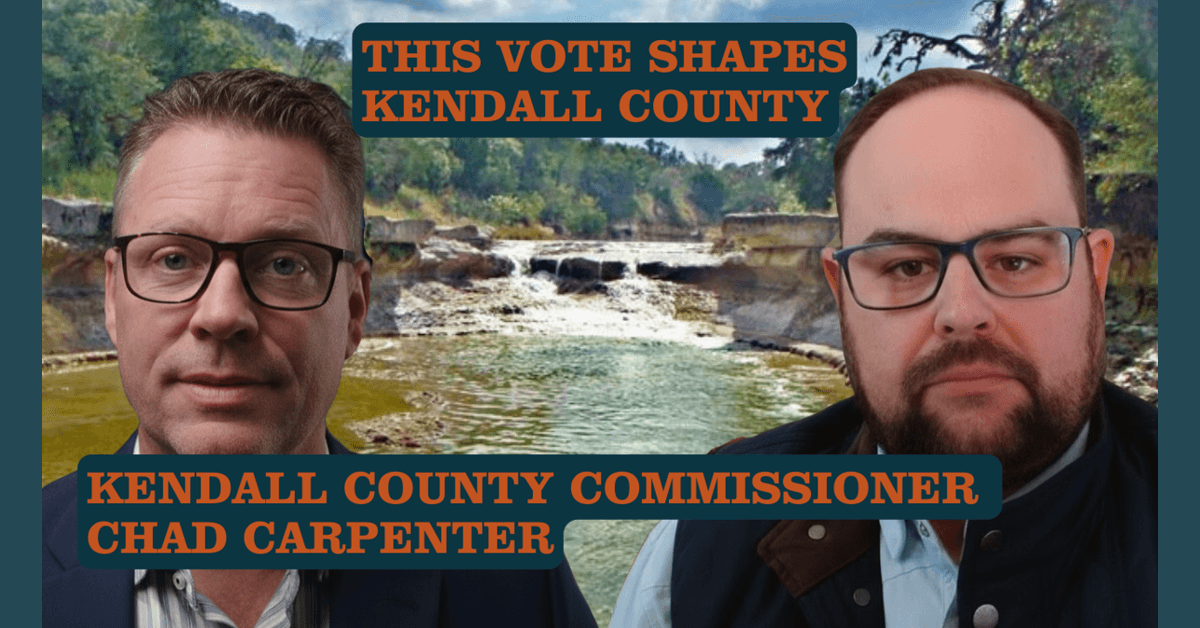
As rapid growth transforms Texas Hill Country communities, a recent episode of Vote Like a Texan examines the significant influence of county-level leadership on local decision-making. Host Justin McKenzie interviewed Kendall County Commissioner for Precinct 4 Chad Carpenter, who is seeking reelection, discussing infrastructure, water availability, private property rights, emergency services, and the role of county commissioners in Texas governance.
Commissioner Carpenter explained that his decision to run for office originated from personal experience navigating local regulations. He stated that increasing costs and complex permitting processes are limiting opportunities for small businesses and landowners. "Local government rules are becoming impossible for small businesses to exercise the American dream," Carpenter said during the interview. "If you want to preserve opportunity for future generations, you have to be willing to step up and be involved."
The episode focuses on educating voters about the power and responsibility of county commissioners, particularly in unincorporated areas where counties serve as the primary layer of government. Unlike cities, Texas counties do not operate under comprehensive master plans. Instead, commissioners court functions as both a legislative and budgetary authority, overseeing roads, emergency services, land-use regulation, and coordination with state agencies. "Commissioners court is where decisions are made that affect landowners, ranchers, small businesses, and first responders," McKenzie noted. "These decisions impact daily life long before most issues ever reach the state level."
The conversation highlights growing concerns about large-scale residential development in Kendall County and the strain such projects place on water resources, firefighting capacity, and rural infrastructure. Carpenter emphasized that Kendall County is designated by the state as a Priority Groundwater Management Area, indicating long-term concerns about water sustainability. He argued that development decisions must balance private property rights with the responsibility to protect shared resources. "You have a right to use your property," Carpenter said, "but your neighbors also have a right to protection when a project threatens water availability or emergency response capacity."
The episode also addresses recent county investments in emergency services, including expanded full-time firefighter coverage and ongoing support for volunteer fire departments. Another major topic discussed is the rapid expansion of battery energy storage facilities across Texas. Carpenter raised concerns about the lack of local regulatory authority over such projects, noting that counties currently have limited ability to consider proximity to schools, aquifers, or rivers when developments are proposed. "These projects are moving faster than regulation," Carpenter explained. "Local governments need clearer authority to protect communities while still supporting responsible infrastructure."
The episode concludes with a call for civic engagement, particularly in primary elections where turnout is often low but outcomes shape general election choices. "If people want a voice in who represents them, the primary election is where that voice matters most," McKenzie said. Carpenter encouraged residents to attend commissioners court meetings, ask questions, and stay informed about local governance. The interview series aims to give voters direct access to candidates and officeholders, with more information available at https://www.votelikeatexan.com.