

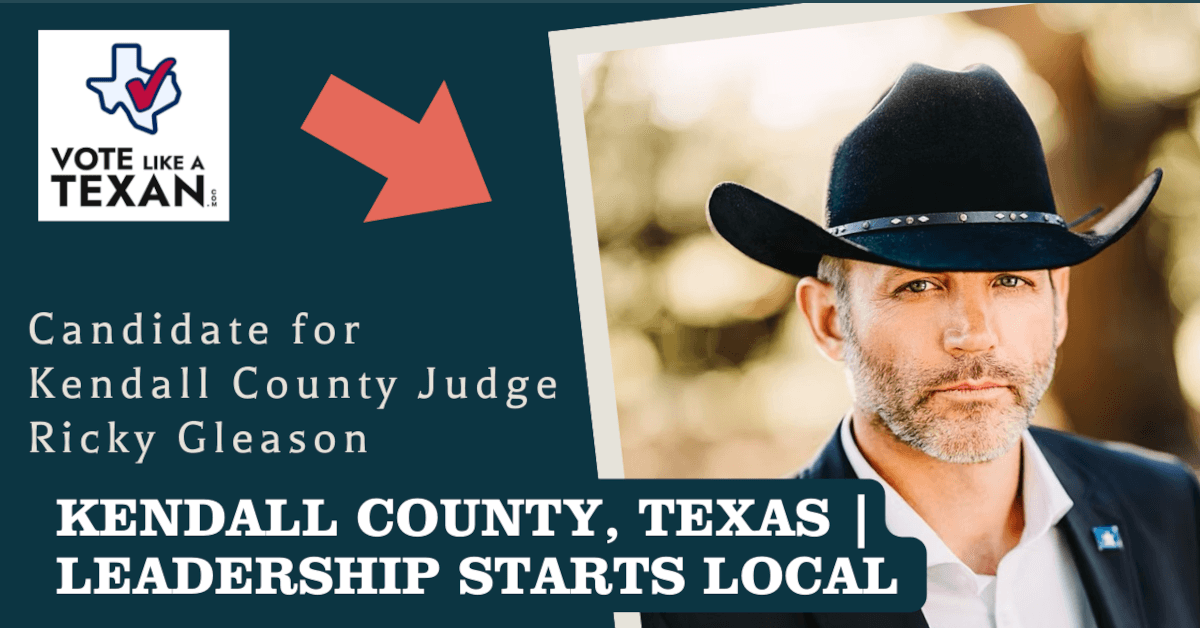
Ricky Gleason, a candidate for Kendall County Judge, is advocating for a fundamental shift in leadership that treats county government as a partner to residents rather than an adversary. As Kendall County faces intensifying growth and public safety challenges, Gleason emphasizes that leadership should begin with listening to citizens, first responders, businesses, school districts, and municipalities.
Gleason points to Comfort Vision 2050, a community-crafted roadmap developed by Comfort residents, as proof that collaborative, ground-up planning works. The plan, created across generations and professions, highlights decentralized decision-making, transparency, and coordination—principles Gleason says must guide county governance. "At its best, county government should be a partner to its citizens—not an adversary," said Gleason. "The County Judge sets the tone. That tone should bring people together, not push them apart."
Gleason's platform centers on creating conditions where local ideas can thrive in critical areas including road and bridge planning, emergency management, fire and EMS services, and economic development. He argues that Kendall County currently lacks a unified strategic vision despite increasing pressures from growth, environmental hazards, and strained infrastructure. The candidate believes the County Judge must convene voices, align partners, and ensure innovation happens with the people rather than being imposed upon them.
While Comfort Vision 2050 is not a county plan, Gleason sees it as a "proof of concept" for engaged, resident-led planning. The process demonstrated that when invited into the conversation, citizens willingly define shared priorities and practical solutions. "Leadership starts with service," Gleason added. "It means listening first, communicating clearly, and remembering that authority exists to help people succeed—not to control them."
Gleason's approach represents a departure from traditional top-down governance models, positioning county government as a facilitator rather than a director of community development. This shift matters because it addresses the fundamental relationship between residents and their local government at a time when Kendall County faces complex challenges requiring coordinated solutions. "A unified county is a stronger county," Gleason stated. "When government works alongside its people, we solve problems faster, make better decisions, and preserve what makes Kendall County special."
The implications of this governance model extend beyond political philosophy to practical economic impact. For Texas businesses, particularly those operating in or considering expansion into Kendall County, a collaborative government approach could mean more responsive infrastructure planning, streamlined emergency services coordination, and economic development initiatives that reflect actual community needs rather than bureaucratic priorities. This could create a more predictable and supportive environment for business growth and investment.
As Texas communities grapple with rapid growth and development pressures, Gleason's proposal offers a potential blueprint for how local governments can evolve from regulatory bodies to strategic partners. The success of resident-led initiatives like Comfort Vision 2050 suggests that when citizens are empowered to participate meaningfully in planning processes, the resulting solutions are often more practical, sustainable, and broadly supported than those developed through traditional top-down approaches.