

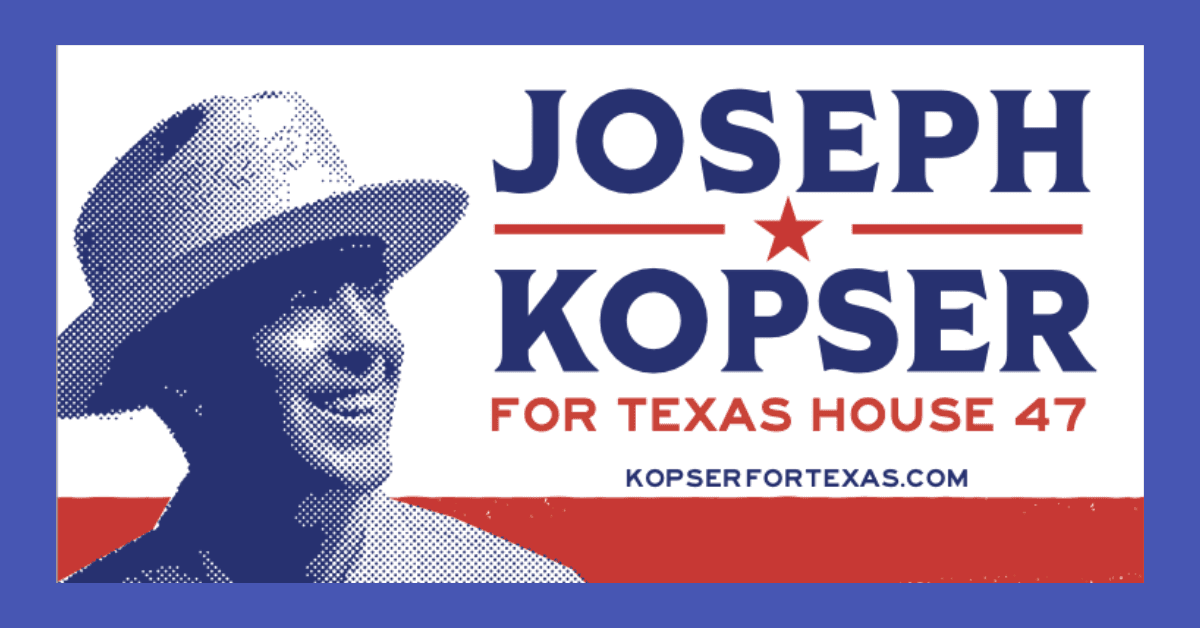
The Kopser for Texas campaign announced it has contacted more than 18,000 unregistered, likely voters who recently moved to Travis County. This proactive effort aims to strengthen civic participation and expand access to the democratic process by focusing on Texans who are eligible to vote but had not yet registered. The campaign's sole purpose is increasing participation in local and state elections.
"For too long, our political system has accepted low participation as normal," said Joseph Kopser, candidate for Texas House District 47. "We believe democracy works best when more people are engaged—not fewer." Kopser has led USTomorrow for the past seven years, an organization dedicated to reinvigorating disengaged and disenfranchised voters through education, dialogue, and civic awareness. In a recent USTomorrow piece, Kopser highlighted March Matters, a non-partisan initiative focused on educating voters about the outsized impact of primary elections.
"While it may be unconventional in modern politics, we set out to expand the voter base—period," Kopser said. "The recent upset victory of political outsider and Democrat Taylor Rehmet shows what happens when voters register, show up, and motivate their friends. When people participate, anything is possible." The campaign emphasized that expanding participation is not a partisan goal, but a civic one aimed at ensuring Texas elections reflect the voices of the communities they serve.
In addition to voter registration outreach, Kopser for Texas is deploying relational organizing strategies using the Reach App, a tool pioneered in Texas by Blue Action Democrats. This approach empowers supporters to engage friends, family members, and neighbors by leveraging trusted relationships rather than impersonal political messaging. "Registering more voters, combining that effort with relational organizing, and using tools like the Reach App alongside traditional campaign strategies will turn out more voters," Kopser added. "And that's always a good thing for democracy."
The implications of this voter registration drive extend beyond immediate electoral outcomes. By systematically engaging thousands of newly arrived Texans who might otherwise remain outside the political process, the campaign addresses a fundamental challenge in Texas democracy: ensuring that growing communities have proportional representation. This effort could reshape political engagement in Travis County, one of Texas's fastest-growing regions, by bringing more diverse voices into local and state decision-making.
For Texas businesses, increased voter participation means more responsive government policies that reflect the actual needs of communities. When elections better represent the population, policies on infrastructure, education, and economic development are more likely to align with public priorities. The campaign's focus on relational organizing through tools like the Reach App represents an innovative approach to civic engagement that could influence how future campaigns operate across Texas.
The economic impact of expanded democratic participation is significant. Research consistently shows that higher voter turnout correlates with policies that benefit broader economic interests rather than narrow special interests. For Texas companies, this could mean more stable regulatory environments, better-funded public infrastructure, and educational systems that produce a stronger workforce. The campaign's non-partisan approach to voter expansion suggests a recognition that healthy democracy serves all economic stakeholders, regardless of political affiliation.