

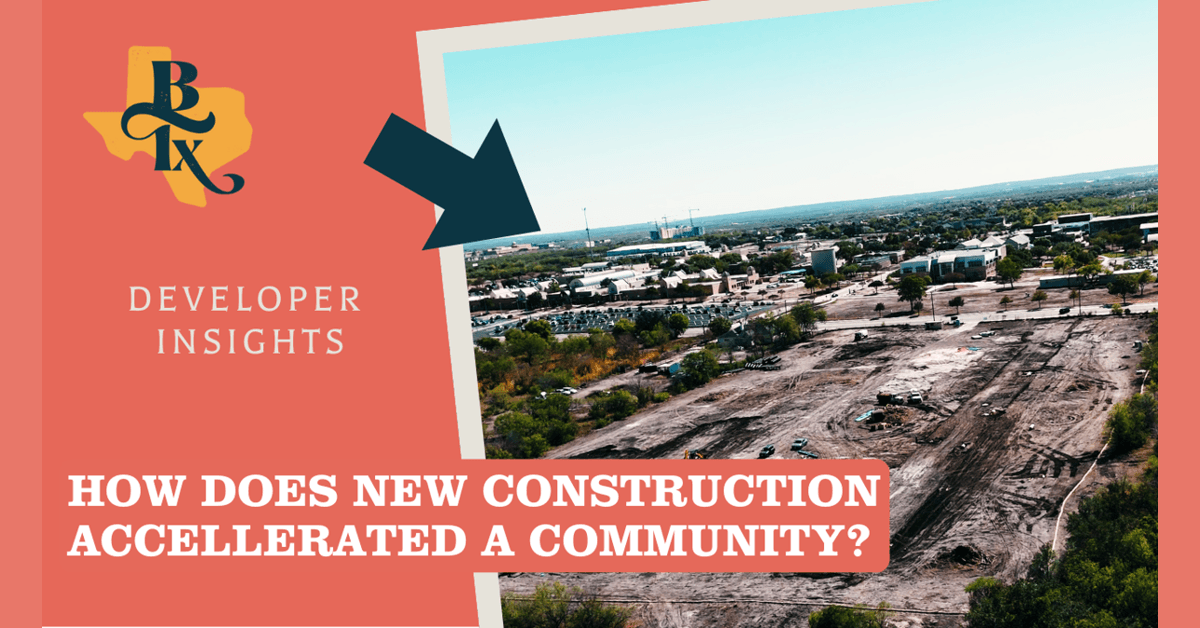
Developer Gilley Mendoza detailed his company's strategy for South San Antonio's development during an episode of The Building Texas Show, emphasizing community-aligned housing and long-term regional impact. As founder of Gilley International Group, Mendoza explained how his firm is focusing on the corridor between Loop 410 and Loop 1604, an area he identified as one of Texas' most promising growth regions with significant greenfield opportunities.
The region's development momentum is supported by major institutional anchors including Palo Alto College, which sits directly across from Mendoza's flagship development, and Texas A&M University–San Antonio, one of Texas' fastest-growing universities with a 700-acre master plan. Expanding advanced manufacturing from companies like Toyota and JCB further positions the South Side as an emerging workforce, education, and housing cluster.
During the interview, Mendoza unveiled new details about Villaret Commons, an 80-unit mixed residential community designed for first-generation homeowners, students, and the expanding workforce. The project, located across from Palo Alto College, will feature 19 duplexes and 42 single-family homes with horizontal construction including roads and utilities scheduled for completion within 45 days. More information about the development philosophy can be found at https://youtu.be/TWo74ePiNSQ.
Mendoza emphasized what he calls "approachable housing"—homes priced between $250,000 and $300,000 to match South Side manufacturing and trade job salaries without compromising quality. "I didn't say it was 'affordable' housing," Mendoza explained. "But we are intentionally building homes in that range because that's where the community's workforce is. That's the opportunity." This pricing strategy addresses a critical gap in the market between traditional affordable housing and luxury developments.
The developer acknowledged challenges in building within neighborhoods where he grew up, noting that while some residents express skepticism toward developers, most community members want better retail, housing, and options. Mendoza believes transparency and engagement are essential to successful development. "I grew up here," he said. "I'm willing to do the work, have the conversations, and build what this community deserves."
Host Justin McKenzie praised Mendoza's approach as "the best kind of development we can hope for—local investors reinvesting in their own community with intention, long-term thinking, and respect for San Antonio's heritage." The episode highlighted how community-driven development can create sustainable growth while addressing specific regional needs, particularly in areas experiencing rapid institutional and economic expansion.
The implications of this development strategy extend beyond immediate housing construction. By aligning home prices with local manufacturing and trade salaries, Mendoza's approach directly supports workforce retention and economic stability in South San Antonio. This model demonstrates how targeted development can bridge the gap between institutional growth and community needs, creating a more integrated economic ecosystem.
For Texas businesses and developers, Mendoza's strategy offers a blueprint for community-aligned development that balances economic opportunity with social responsibility. The focus on the corridor between Loop 410 and Loop 1604 represents a strategic investment in one of Texas' most promising growth regions, potentially influencing development patterns throughout the state as other areas face similar housing and workforce challenges.