

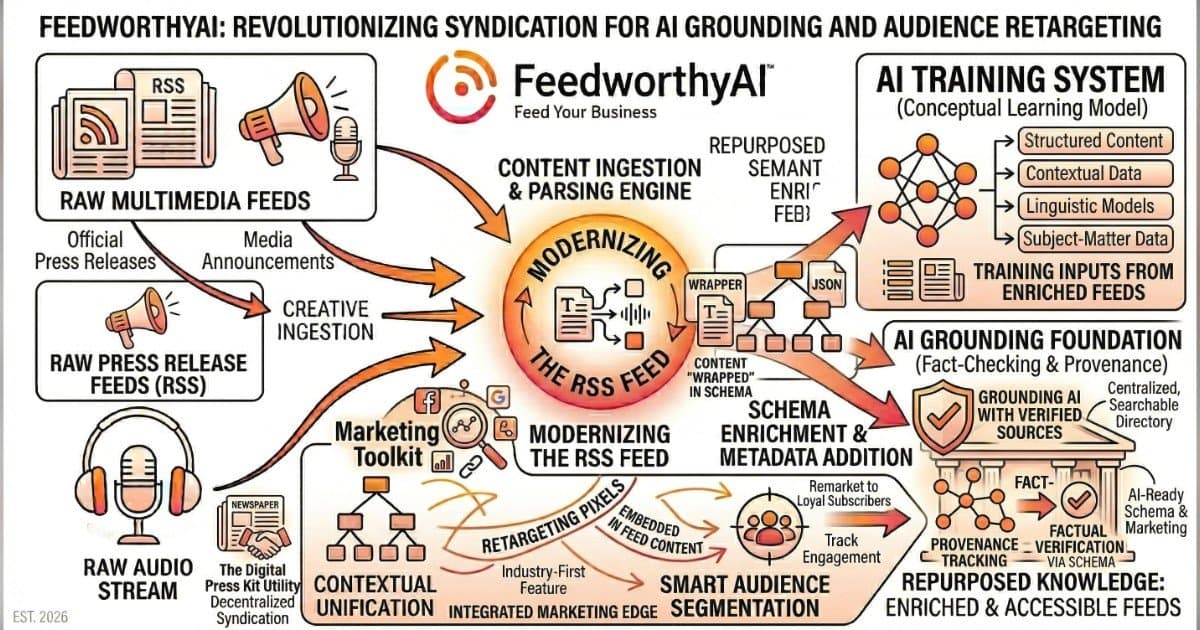
The launch of FeedworthyAI addresses the growing need for publishers to make their work accessible to both human audiences and artificial intelligence systems. This free utility modernizes the RSS protocol to serve the demands of generative AI and contemporary marketing, operating in an online environment increasingly dominated by proprietary algorithms and walled platforms.
RSS, developed in the late 1990s, once formed the backbone of the open web by allowing direct subscriptions to blogs and news sites. Its decline coincided with the rise of social media platforms that prioritized algorithmic feeds over user-controlled connections. However, as dissatisfaction with opaque algorithms grows among users and publishers seek more reliable distribution channels, RSS is experiencing a notable resurgence. FeedworthyAI capitalizes on this trend by providing tools that enhance the basic feed infrastructure for modern applications.
The platform operates through a two-fold approach. First, it maintains a global directory where publishers can submit their RSS feeds to a curated, searchable index at https://feedworthy.ai. This makes niche content more discoverable to AI aggregators, researchers, and dedicated users. Second, it applies advanced schema to feed content. This structured metadata tells AI systems precisely what the content is and establishes its reliability for purposes like AI training or AI grounding, which involves fact-checking and real-time information retrieval.
Beyond improving AI comprehension, FeedworthyAI introduces integrated retargeting pixels directly within feed content, a first for the industry. This feature allows publishers to track engagement and remarket to their RSS subscribers across other digital platforms. The system supports pixels from seven major advertising and analytics services, including Google Ads and Meta, ensuring compatibility with existing marketing technology. This transforms passive RSS consumption into a measurable, cross-channel lead-generation tool, giving creators valuable insights into their audience's behavior.
Industry response has been positive, with creators highlighting the platform's potential to solve distribution challenges. Justin McKenzie, host of the Building Texas Show podcast, noted that the tool bridges the gap between traditional syndication and modern discovery, making content easier to find and value by the next generation of search and AI tools. By offering these services at no cost, FeedworthyAI aims to democratize access to advanced distribution technology, ensuring independent journalists and small publishers can compete with larger entities in terms of AI visibility and audience engagement.
The initiative underscores a broader movement toward a more structured, open, and decentralized web where content creators retain greater control over how their work is distributed and understood. For Texas businesses and organizations featured on platforms like the Building Texas Show, this development could significantly enhance their ability to reach target audiences through both human readers and AI-driven systems, potentially increasing their economic impact across the state.